.avif)

Data storytelling is no longer a nice-to-have. In 2026, leaders expect teams to translate complex analysis into clear narratives that drive decisions. Whether you are presenting campaign performance, product metrics, financial trends, or customer insights, your ability to communicate data effectively determines whether your audience understands the message or gets lost in the numbers.
The most effective data storytellers do more than show charts. They guide attention, provide context, clarify implications, and shape a narrative around what the data actually means. Instead of overwhelming stakeholders with dashboards, they focus on insight and action.
Below are five proven, research-backed frameworks used by high-performing teams to communicate insights clearly and persuasively.
1. The “So What?” framework
One of the simplest and most powerful data storytelling tools is the “So What?” framework. Rather than presenting a metric and moving on, this approach forces you to clarify its relevance and implications.
It follows a three-step structure: identify what happened, explain why it matters, and recommend what should happen next.
For example, imagine web conversions dropped 14 percent quarter over quarter. That is the observation. The “so what” might be that paid traffic quality declined, reducing lead quality and downstream revenue potential. The recommended action could be shifting budget toward higher-intent organic channels and retargeting campaigns.
This framework prevents data dumping and ensures that every insight is tied directly to business impact. Executives do not want more numbers; they want clarity on what those numbers mean and what decisions should follow.
2. McKinsey’s pyramid principle
Popularized in management consulting, the Pyramid Principle structures communication from the top down. Instead of building toward a conclusion, you begin with the answer and then support it with evidence.
In practice, this means opening a presentation with your main conclusion, followed by two to four key insights that support it, and then reinforcing each insight with relevant charts or analysis.
For example, you might begin with: “Customer retention is declining due to onboarding friction.” You would then support that statement with data showing increased early churn, lower feature adoption in the first week, and feedback highlighting confusion in setup flows.
Research consistently shows that decision-makers form impressions quickly. Leading with the answer respects their time and makes complex information easier to process. Rather than forcing your audience to interpret data independently, you guide them through a structured argument.
3. The OIA framework: Observation, insight, action
The Observation–Insight–Action framework is especially effective for operational and product teams. It breaks data communication into three disciplined steps.
First, state the observation clearly. This is the neutral description of what the data shows. Next, interpret the data to uncover the insight, explaining why the change occurred or what pattern it reveals. Finally, define a specific action based on that understanding.
Consider a scenario in which feature adoption increases by 22 percent after a product redesign. The observation is the increase. The insight may be that improved onboarding reduced friction during the first session. The action would be to apply similar onboarding improvements to other parts of the product experience.
By separating observation from interpretation, this framework reduces confusion and ensures that recommendations are grounded in evidence rather than assumptions.
4. The data-to-story arc
Data does not have to feel dry. Borrowing from classic storytelling structure, the data-to-story arc turns analysis into a narrative with momentum and meaning.
It follows a simple progression: establish context, introduce tension or change, and resolve it with a recommendation.
You might begin by showing that customer churn has historically remained stable. That is the setup. The conflict emerges when early-life churn spikes by 12 percent in the most recent quarter. The resolution involves proposing improvements to onboarding, pricing clarity, or customer support to address the issue.
Humans are wired to remember stories more effectively than isolated statistics. By framing analytics within a narrative arc, you make insights more memorable and emotionally resonant, increasing the likelihood that stakeholders will act.
5. The 1–3–1 framework
When datasets feel overwhelming, simplicity becomes your greatest asset. The 1–3–1 framework helps distill complexity into a focused message.
You begin with one core idea. You then support it with three pieces of evidence. Finally, you close with one clear takeaway or recommendation.
For example, your main idea might be that organic search is your most efficient growth engine. Supporting evidence could include 48 percent lower customer acquisition costs compared to paid channels, the highest lifetime value across acquisition sources, and consistent quarter-over-quarter growth. The takeaway would be to increase organic investment by 20 percent in the next planning cycle.
This structure keeps slides clean and persuasive, making it particularly effective for quarterly business reviews, dashboards, and board presentations.
How Beautiful.ai helps you tell better data stories
Applying these frameworks becomes significantly easier when your presentation tool reinforces clarity rather than adding complexity. Traditional slide software often requires manual formatting, layout adjustments, and visual fine-tuning, which can distract from the narrative itself.
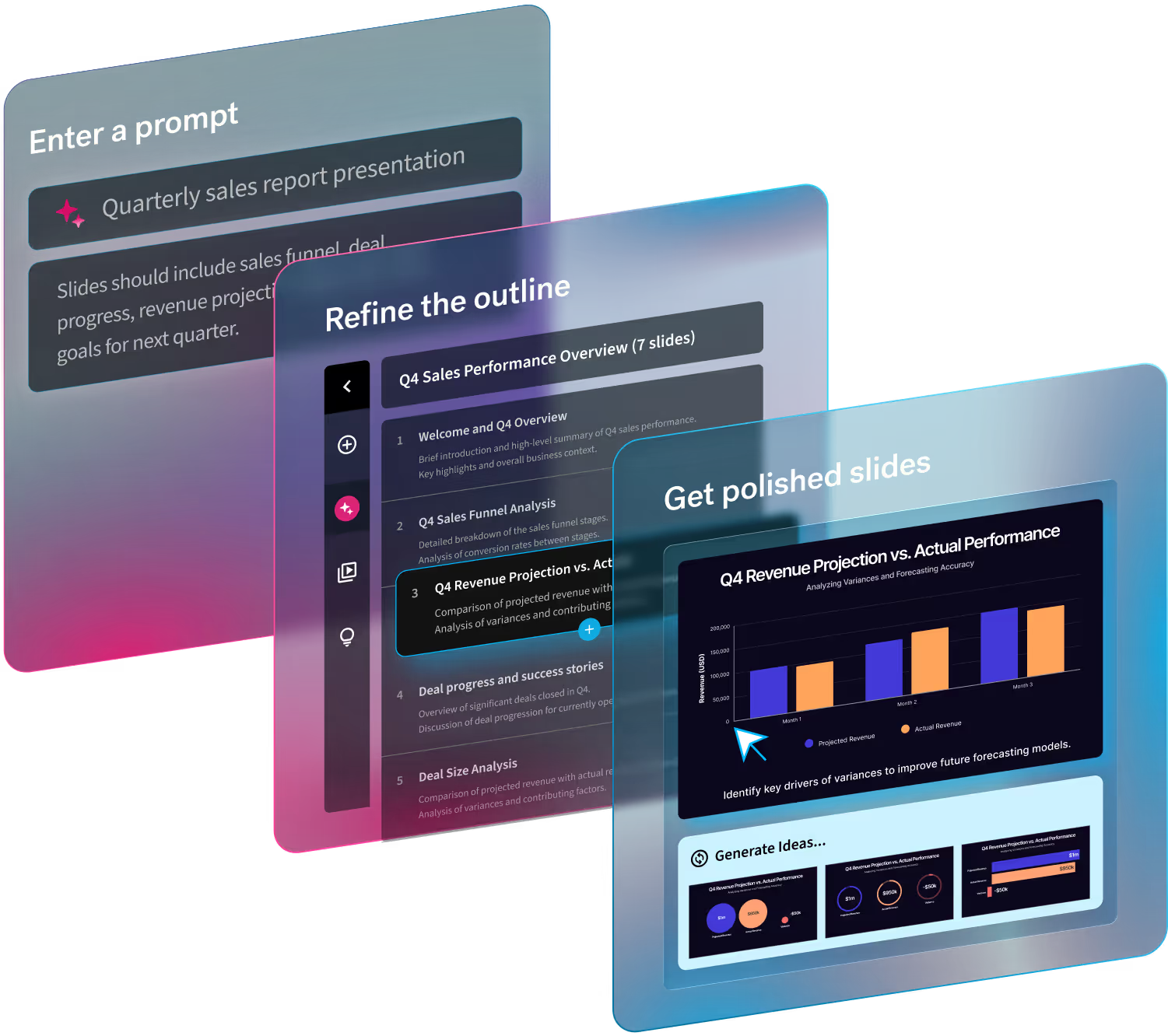
Beautiful.ai is designed to support modern data storytelling by embedding design best practices directly into the platform. Smart Slide layouts automatically adjust as you add content, ensuring charts, headlines, and key metrics remain visually balanced and easy to interpret. Prebuilt layouts help you highlight critical numbers, reduce clutter, and keep slides focused on insight rather than decoration.
By automating chart and graph formatting, and maintaining brand consistency across teams, Beautiful.ai allows presenters to concentrate on structuring their data in a way that tells a story. The result is clearer communication, stronger executive alignment, and faster decision-making.
Tell better data stories in your next presentation
In today’s data-rich environment, the differentiator is not access to information but the ability to interpret and communicate it clearly. Whether you are presenting to leadership, sharing campaign results, or explaining product trends to stakeholders, structured storytelling frameworks transform analysis into action.
When you combine disciplined narrative structure with clean, modern slide design, your audience no longer asks, “What does this mean?” They understand the insight, the implication, and the next step.
Data visualization that works is not about showing more. It is about communicating what matters.